
Skip to content

Large Straight Trucks

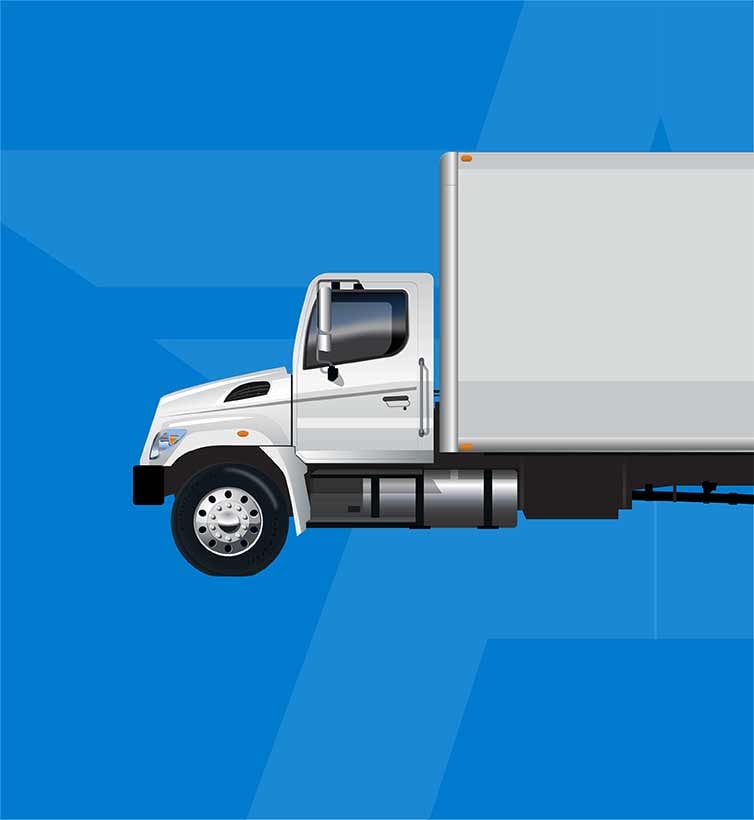
Straight trucks combine flexible loading with dedicated, direct delivery for time-critical freight across town or across state lines.
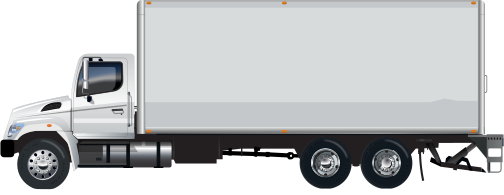
hero-straight-truck

EXPEDITED DELIVERY SOLUTIONS

What are Straight Trucks?

A straight truck is a commercial vehicle with the cab and cargo area mounted to the same chassis, creating one rigid unit with no detachable trailer. Unlike a tractor-trailer, everything travels together—a simple distinction that gives straight trucks greater flexibility in where they can operate, load, and deliver.

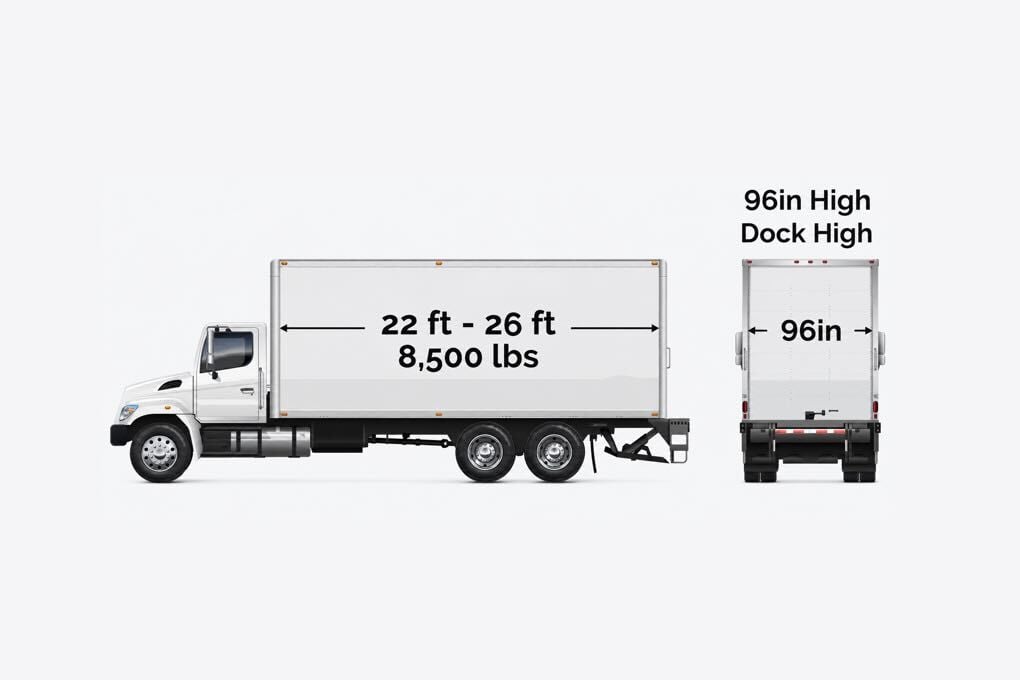
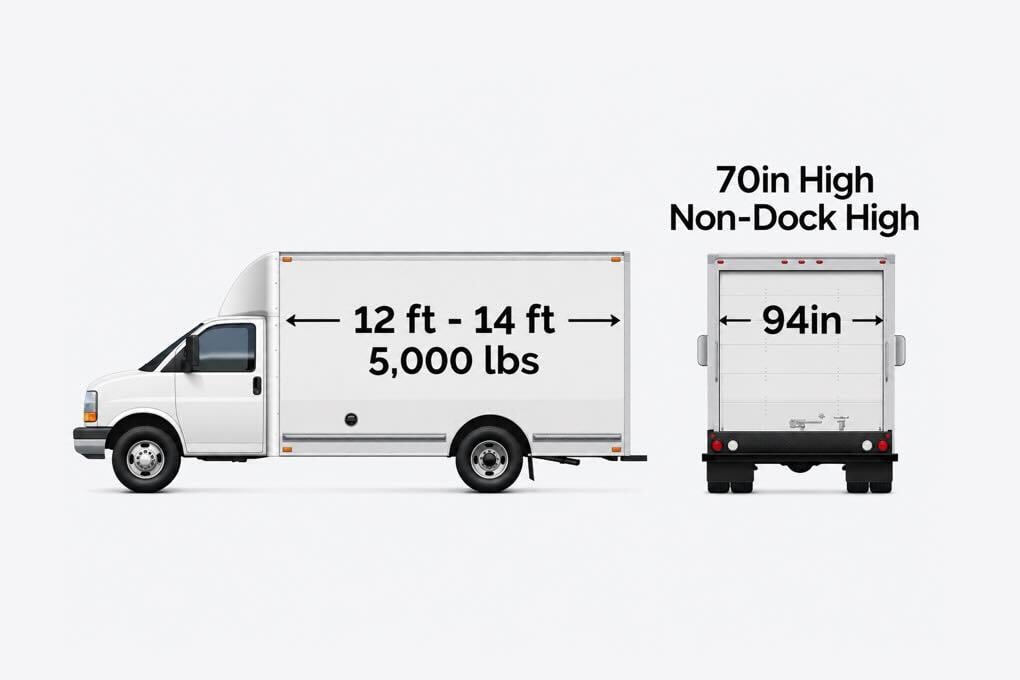
Straight trucks come in a wide range of sizes. Smaller models typically have 12- to 16-foot cargo bodies and work well for a limited number of pallets, while larger 22- to 26-foot trucks provide substantially more floor space, interior height, and payload capacity. Many larger models also sit at standard dock height for straightforward forklift loading and unloading. Because dimensions, weight limits, and availability vary by configuration, the specifications of the assigned truck should always be matched to the shipment.

Most straight trucks have enclosed cargo bodies, which is why the terms straight truck and box truck are often used interchangeably. The category can also include flatbeds, stake beds, and refrigerated trucks. Equipment such as liftgates expands delivery options at locations without a dock, while e-track and load bars help secure cargo in transit. Air-ride suspension can provide additional protection for sensitive freight.

For urgent shipments, the biggest advantage is the combination of capacity and accessibility. A large straight truck can back into a plant dock and unload by forklift much like a trailer, yet remain maneuverable enough to serve job sites, commercial properties, and urban locations where a full tractor-trailer may be impractical. That versatility makes straight trucks especially useful when a shipment is too large for a cargo van but does not require a full-size trailer.

ExpeditedFreight.com coordinates dedicated straight truck capacity nationwide for time-critical freight. Each truck is reserved for a single customer’s shipment, departs as soon as loading is complete, and travels directly to the destination—without terminals, consolidation, or scheduled network stops.

Request a Quote Now

Add your shipment details below, and one of our professional expeditors will contact you within minutes. For immediate assistance on an urgent quote, call (800) 704-7145 with these details handy.

Ground Transportation-1-1

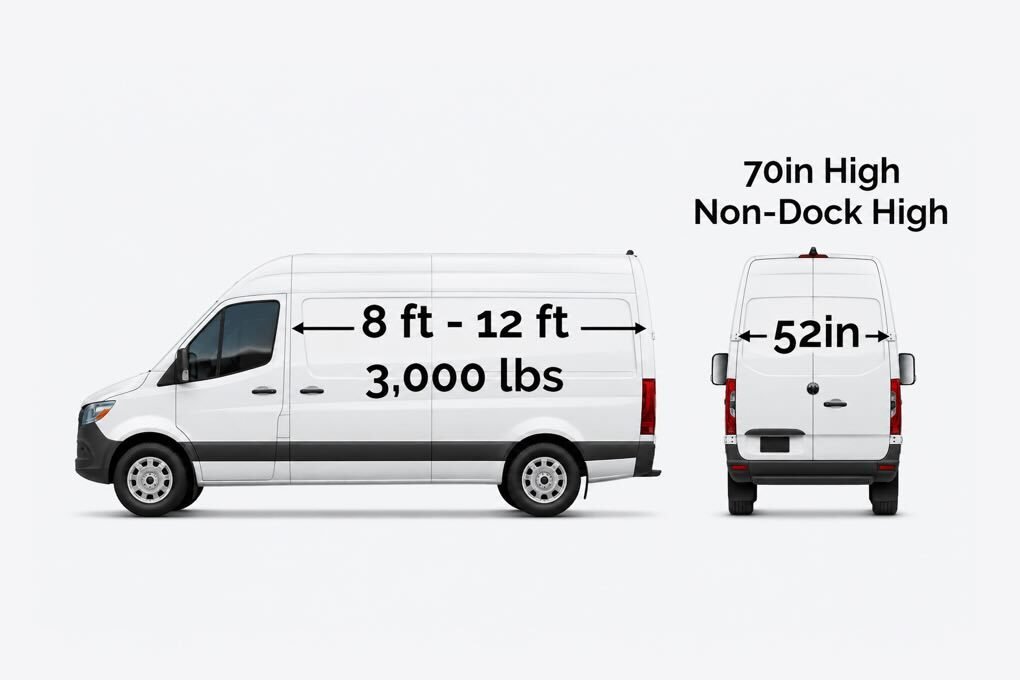
Sprinter vans are highly regarded for their flexibility and maneuverability.

Cargo-1

Cargo capacity 3-4 pallets, maximum payload 3,000 lbs.

Package tracking

Easily navigate through urban areas and steer clear of traffic congestion.

Hub to spoke

Designed for easy manual loading and unloading.

Large Straight Truck Cargo Capacity

Standard cross-section is 96” square and interior cargo area length is between 22’ and 26’. Two-axle trucks typically have a GVWR of under 26,000 pounds while a third axle allows total weight to go up to 54,000 pounds. (Note that when GVWR exceeds 26,000 pounds the driver requires a Commercial Driver’s License (CDL) of the appropriate Class.)

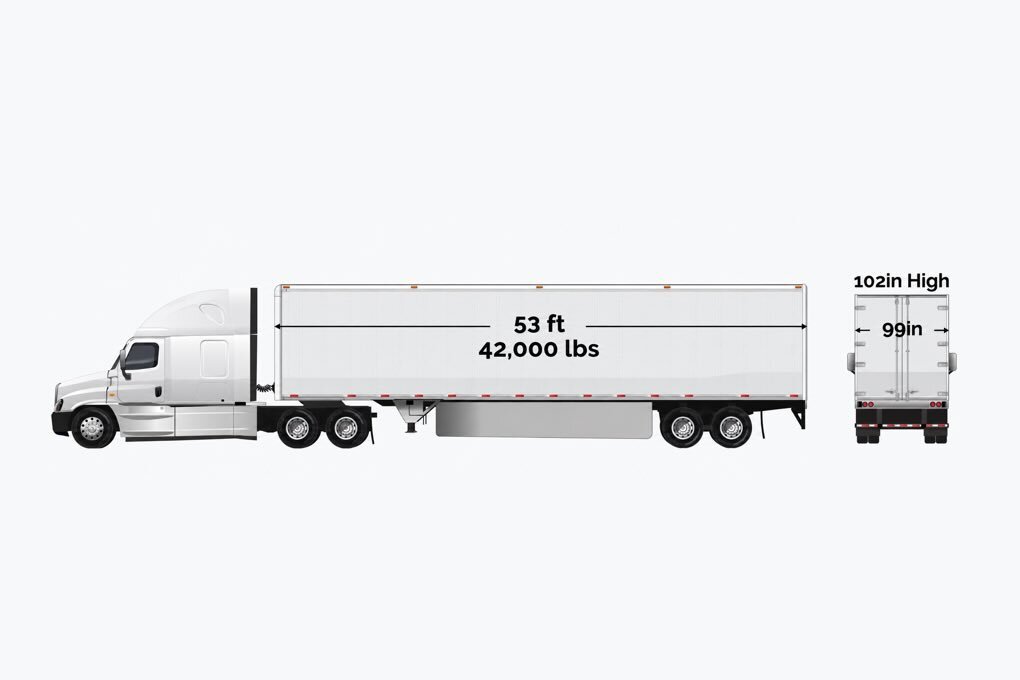
Given that a standard pallet measures 48” x 40”, a large straight truck can take two rows of pallets. Shorter trucks will be full at a total of 10 pallets while longer models will accept 12. In urgent, “Line Down” freight applications, this is often enough to get or keep a production cell or plant running while a 53’ dry van is being loaded with a larger quantity.

TYPES OF CARGO

These trucks are used for expedited delivery of larger quantities and larger items.

Checkmark
While often used for just-in-time delivery of pallets, cages, and dedicated dunnnage, they’re just as effective for urgently needed and sensitive manufacturing and laboratory machinery and tools, test equipment, inspection tools and devices, and specialized analytical equipment.
Checkmark
Whether it’s in cartons, hard-sided plastic cases, wheeled bins, or dedicated cradles, if it fits, a straight truck can carry it.
Checkmark
Other cargo these trucks carry includes presentation and display equipment, urgently needed materials and subassemblies.
Checkmark
On occasion, they’re even used for moving sporting equipment between venues (an application where late arrival is never, ever acceptable!)

ExpeditedFreight.com: Straight Truck Service Built Around the Deadline.

KEY BENEFITS

NATIONWIDE NETWORK
SINGLE POINT OF CONTACT
DEDICATED EXPERTISE
REAL-TIME TRACKING

Urgent freight is won or lost in the sourcing.

ExpeditedFreight.com works through a nationwide carrier network to identify a suitable straight truck close to the origin, which cuts the repositioning time that so often determines whether a shipment loads today or tomorrow. Reach across the full size range matters as well: a load needing 20 feet of floor and a dock-height deck draws from a different pool than one that fits a 16-foot body, and having access to both prevents an urgent shipment from being forced into equipment that does not suit it.

EXPLORE OUR COVERAGE

ef-coverage-3

Range and Routes

Large straight trucks handle hot shot shipping needs throughout North America. While usable in metropolitan and urban areas, their forte is longer-distance expedited trucking between major hubs — from city-to-city service to interstate deliveries and even cross-border expedited shipments. Being smaller and lighter than 53-foot dry vans, large straight trucks can sometimes use routes with height and weight limits, saving vital minutes when the goal is the fastest delivery possible.

End to End Solutions

For companies needing direct delivery of medium-to-large shipments, large straight trucks provide significant advantages by reducing handling, cutting damage risk, and eliminating hub transfers. Equipped with real-time tracking, smart routing, and dedicated freight options, they boost supply chain transparency and dependability. These trucks also support just-in-time delivery approaches, helping firms reduce warehousing expenses and maintain smooth inventory flow across retail, healthcare, and manufacturing operations.

KEY VEHICLE SPECIFICATIONS

Maximum GVWR

54,000 pounds, but note that this requires a CDL driver. Non-CDL drivers are restricted to a maximum GVWR of 26,000 pounds. Straight trucks with a GVWR exceeding 26,000 pounds usually have three axles.

Interior dimensions

Width: 96”, height: 96”, length: 22 to 26’. (This is enough for two rows of 6 standard pallets.)

Loading

Floor will be level with most loading docks.

Range

Can be up to 1,200 miles between refueling stops, depending on route, engine, and fuel tank capacity.

REQUEST A QUOTE

Reach out today and let's solve your urgent shipping needs.

CONTACT US

Customer Reviews

5.0 / 5

551 Reviews

Trusted by Businesses Nationwide

See customer feedback about our service, communication, and expedited shipping support.

Rated by customers on Google

Your Time-Sensitive Cargo Needs a Dedicated Freight Team

Expedited Trucking

Large Straight Truck Advantages

Large straight trucks offer significant advantages for expedited freight, especially when transporting medium to large-sized loads. Their spacious cargo areas can accommodate heavier and bulkier shipments, making them ideal for industries requiring rapid delivery of substantial goods. Additionally, large straight trucks often have the flexibility to access areas that might be challenging for full-sized tractor-trailers, making them a good choice for both urban and suburban deliveries. Their ability to operate over long distances further enhances their value in expedited logistics.
Ground Transportation-1-1

Capabilities

A large straight truck features a sturdy, fixed frame with a boxy, solid-walled cargo compartment situated right behind the driver’s cab. Engineered for both efficiency and adaptability, these trucks are available in two-axle or three-axle versions, the extra axle boosting payload potential. With roughly double the capacity of a box truck yet half that of a semi-trailer, they hit a sweet spot between cargo space and agility. This makes large straight trucks an excellent fit for transporting hefty loads while still managing to weave through confined areas.

Long Distance Service

Long Distance Service

For long-distance hauls, straight trucks often outpace semis, leveraging their smaller, lighter build to travel direct routes that navigate under bridges with height and weight constraints. They offer superior handling and fuel efficiency compared to semi-trucks, while providing significantly more space than box trucks or Sprinter vans. For companies seeking a mix of payload capacity, speed, and adaptability, large straight trucks stand out as a prime solution for long-haul and time-sensitive freight demands.

Versatility

Versatility

Large straight trucks excel equally in long-haul journeys and bustling urban settings, proving their worth in both scenarios. They’re perfectly suited for urgent shipments of sizable freight, including loads that demand several pallets or containers. With various loading and unloading configurations, they offer impressive flexibility. This blend of versatility and performance positions large straight trucks as a trusted option for companies needing consistent, expedited freight services.

SDD Icon

Loading

Large straight trucks are designed with a floor height that matches standard loading docks, making manual loading and unloading—or the use of a pallet truck—straightforward and efficient. However, they aren’t built to accommodate forklift loading. Most forklifts are too tall to fit within the cargo space, and their weight often surpasses the floor’s load-bearing limit. There’s also a chance that the truck’s front end could lift as a forklift moves in, particularly since the rear extends past the axle. Thus, selecting loading equipment that aligns with the truck’s structure and capacity is crucial.

Safety

Safety

Large straight trucks bring significant safety benefits to expedited freight transport, safeguarding both cargo and drivers. Their solid, unarticulated frame delivers superior stability over jointed vehicles, lowering the chances of tipping or jackknifing during abrupt turns or stops. Outfitted with cutting-edge safety tools like anti-lock brakes (ABS), electronic stability systems, and collision avoidance tech, these trucks boost driver command and cut down on crash hazards. The fully enclosed, sturdy cargo compartment protects shipments from weather and physical harm.

Technology

Advanced Tracking Technology

When waiting on time critical shipping, confidence in it arriving when promised enables better resource coordination and activity planning. Expedited Freight supports this through the use of advanced tracking technology. Real-time updates on truck location let the customer know their express delivery is on its way, and they also let us reroute the driver if weather or traffic problems threaten delays.

Industries That Rely on Straight Trucks

oil-gas-1

Oil & Gas

Processing facilities and field operations need urgent freight that is heavy for its footprint and awkward to handle. Expedited straight trucks carry heat exchangers, filtration skids, valve actuator packages, and insulated pipe spools from fabrication shops to plants and field sites. Larger bodies accommodate skidded assemblies that smaller vehicles cannot take at all.

LEARN MORE

data center

Technology

Data center infrastructure fails at a scale that requires more than a van. Straight truck delivery moves precision cooling units, busway sections, rack-height UPS systems, containment components, and seismic frames to facilities under construction or under pressure. Dock-height loading and air-ride suspension both matter here, since this equipment is heavy, tall, and unforgiving of rough handling.

LEARN MORE

manufacturing-1

Automotive

Plant maintenance and changeover work generates urgent freight larger than a parts shipment. Straight trucks deliver paint system components, weld cell fixtures, conveyor carriers, engine dress assemblies, and smaller press tooling between suppliers, tool shops, and assembly plants. Facilities built entirely around dock receiving can turn a large straight truck quickly without occupying a trailer door.
Learn More

construction-1

Construction

Schedule recovery on a project often depends on one large item arriving. Expedited straight trucks carry rooftop HVAC units, curtain wall and glazing crates, hoist components, and temporary chillers to active sites. A liftgate-equipped truck sets freight on the ground without a crane, and its length works where a tractor-trailer cannot turn around.

LEARN MORE

retail

Manufacturing

A production stoppage drives immediate decisions about equipment as well as parts. Straight truck freight moves extruder screws and barrels, palletized dies, robot arms, and vacuum pumps between vendors, rebuilders, and plants. For a recovery shipment measured in a few thousand pounds, a dedicated straight truck is faster than a network and better sized than a trailer.

LEARN MORE

aerospace

Aerospace & Defense

Program hardware includes items that are large, valuable, and closely controlled. Straight trucks transport tooling frames, nacelle and structural components, ground handling carts, reusable shipping containers, and test equipment between plants, MRO facilities, and installations. Exclusive use limits handling exposure, and air-ride equipment protects assemblies where vibration is a genuine concern rather than a precaution.
LEARN MORE

Machinery

Machinery

Equipment builders and service organizations move machines and major assemblies under time pressure regularly. Expedited straight trucks carry crated machining accessories, gear cases, industrial chillers, welding systems, and compressors to plants and repair facilities. Weight per piece is usually the governing constraint, so liftgate ratings are checked against the heaviest single item rather than the shipment total.
LEARN MORE

Mining

Mining

Remote operations lose ground quickly when major components fail. Straight truck delivery brings pump barrels, rewound motors, ventilation ducting, hydraulic cylinders, and heavy wear components to mine sites and processing plants. Enclosed bodies protect rebuilt assemblies across long unpaved approaches, and the shorter wheelbase handles site roads and switchbacks that defeat longer combinations.

LEARN MORE

Telecommunications

Telecommunications

Network builds and outage restoration both generate freight at this scale. Expedited straight trucks move prefabricated equipment frames, DC power plants, shelter HVAC units, and large cabinet assemblies to central offices, tower sites, and staging yards. Liftgate capability is close to mandatory, since compounds and shelters are rarely built with dock access.

LEARN MORE

Ground Transportation and Expedited Trucking Services

Our team of professionals works tirelessly behind the scenes to ensure every shipment arrives on time, and in optimal condition, at its final destination.
We offer the fastest ground and air transportation options for B2B customers across the United States, Mexico, and Canada.
We’re with you along every mile of your journey. Get peace of mind with a dedicated single point of contact.

The Right Capacity Is Key to Every Urgent Shipment

Your urgent shipment will be the only freight in the sprinter van, box truck, straight truck, hot shot truck, 53’ dry van, or full flatbed to minimize damage and ensure the shipment goes direct from pickup to delivery.

Frequently Asked Questions

What is a straight truck?

A straight truck is a commercial vehicle built with its cargo body mounted permanently to the same chassis as the cab. There is no articulation point and no detachable trailer — the truck and its cargo area travel as a single unit, which is the origin of the name.

Sizes run from compact units with about 12 feet of cargo space up to large models around 26 feet, and while most carry enclosed bodies, flatbed, stake, and refrigerated configurations all exist on the same chassis. What keeps the category busy is that it splits the difference — real capacity without the turning radius, dock dependency, and site restrictions that come with a tractor-trailer.

What is expedited straight truck service?

Expedited straight truck service is deadline-driven freight transportation using a straight truck assigned exclusively to one customer's shipment. Capacity is sourced as quickly as it can be located, the truck loads and departs without waiting for a scheduled slot, and the freight moves directly to its destination.

The difference from standard service is structural. A conventional shipment routes through terminals where it is unloaded, sorted, and reloaded, and each of those steps consumes time. An expedited straight truck skips all of it — one loading, one unloading, and driving in between. Transit becomes a function of distance and federal hours-of-service limits rather than network schedules, which makes it far more predictable even when it is not dramatically faster on paper.

What is the difference between a straight truck and a Sprinter van?

Scale, mainly, along with how freight is handled. A Sprinter-class cargo van has a unified body, a load floor close to the ground, payload in the low thousands of pounds, and room for a small number of pallets. A straight truck has a separate cargo body sitting well above the ground, carries considerably more weight, and offers several times the cargo volume.

The handling difference is often decisive. A van's low floor allows loading by hand or with a pallet jack in many situations. A straight truck generally needs a dock or a liftgate, which is why liftgate-equipped units are so common in expedited work. Choosing between them comes down to weight, pallet count, freight height, and what equipment is available at each end — with weight being the constraint that most often forces the step up.

When should I use a straight truck instead of a tractor-trailer?

Two questions settle it: does the freight actually need a trailer's worth of space, and can the destination take one? Roughly six to a dozen pallets, an urban delivery, a job site, a campus, a retail address, a yard with no room to swing a 53-foot combination — any of these argues for the smaller vehicle.

The trailer wins once volume nears a full load, once palletized weight passes what a straight truck is rated to carry, or once the lane is long enough that cost per pound outweighs everything else, and it is the obvious answer where both ends have real docks. Urgent shipments add one more variable: in a given market on a given day, one of the two may simply be available sooner, and that is a legitimate reason to choose it.

What is the largest load a straight truck can handle?

The upper bound is set by the vehicle's gross weight rating, its empty weight, and axle limits, and it varies substantially across the category. A 26-foot straight truck built on a heavy-duty chassis carries several thousand pounds more than a smaller unit, but published figures for one model line do not transfer to another.

Dimensional limits matter alongside weight. Interior height governs whether freight can be stacked, and the rear door opening — often shorter than the interior — determines what will physically pass through. A tall single crate can be impossible to load into a truck with otherwise ample room. Actual weights and dimensions at booking allow equipment to be matched to both constraints at once.

What is time-critical freight?

Time-critical freight is any shipment whose value depends on arriving by a specific point in time, after which the cost of being late rises sharply or the shipment loses its purpose entirely. A part needed to restart a production line, a component for a scheduled maintenance window, and materials for an event with a fixed date all qualify.

The label changes the planning method. Ordinary freight starts from the cheapest routing and accepts whatever transit falls out of it; time-critical freight starts from the delivery moment and reasons backward to a load time, an equipment class, and a decision about driver teams. Monitoring shifts as well, from confirming what happened to catching what is about to.

What is ground expedite?

Ground expedite covers deadline freight that stays on the road rather than going by air, moving on equipment reserved for a single shipment. The vehicle goes out as soon as capacity can be found and drives origin to destination without stopping for anything else.

The category covers everything from cargo vans to tractor-trailers, with the vehicle chosen to fit the freight. Its advantage over air freight is the absence of transfers: no drive to an airport, no terminal handling, no cutoff times, no second ground leg at the other end. On regional and medium-distance lanes, ground expedite frequently matches or beats air on total door-to-door time at meaningfully lower cost. Over very long distances with extremely tight deadlines, air becomes competitive again, and the two are worth comparing on the actual lane.

What happens if the delivery site has no dock or forklift?

That situation is common on urgent freight and entirely workable, provided it is identified before dispatch. The standard solution is a liftgate — a hydraulic platform at the truck's rear that lowers palletized or crated freight to ground level. Liftgate-equipped straight trucks handle deliveries to job sites, retail locations, office buildings, and field sites routinely.

Liftgates have limits that apply per piece rather than per shipment, so a single heavy crate can exceed a gate's capacity even when the total load is modest. Alternatives include forklift service arranged at the destination, ramps for wheeled items, or delivering to a nearby facility with dock access. The outcome worth avoiding is a truck arriving somewhere that cannot unload it, which is why access is confirmed at booking rather than at the curb.

What is a recovery load?

A recovery load is a shipment moved specifically to correct a disruption that has already occurred. Something failed upstream — a supplier missed a date, a shipment was damaged or misrouted, a quality hold pulled inventory out of service, weather closed a lane — and the recovery load restores the flow before the consequences reach production or the customer.

These shipments are unplanned by definition, which shapes how they are handled. Equipment has to be found on short notice, loading may happen outside normal hours, and the destination is often waiting actively. Straight trucks handle a large share of recovery work because disrupted quantities frequently land in the several-pallet range — too much for a van, not enough to justify a trailer.

Can a straight truck deliver overnight?

Overnight delivery is routinely achievable on regional and medium-distance lanes. A truck loaded in the afternoon or evening can cover several hundred miles within a driver's legal hours and arrive for a morning delivery window, which is one of the most common expedited service patterns.

Longer distances depend on the arithmetic. Federal hours-of-service rules cap daily driving time, so a lane beyond what one driver can cover overnight requires either a later delivery or a driver team. The destination's receiving hours matter too — arriving at 4 a.m. accomplishes nothing if the dock opens at 8. ExpeditedFreight.com works the timeline against the specific lane, pickup readiness, and receiving window before committing to an overnight delivery.

How far can a straight truck travel in a day?

A solo driver operating under federal hours-of-service rules has a limited daily driving window, which in practice translates to a few hundred miles depending on traffic, terrain, weather, and time spent loading and unloading. That figure is a legal and practical ceiling rather than a target, and it is the single most important input when estimating transit on a longer lane.

Assigning a driver team changes the calculation substantially. With two qualified drivers alternating, the truck keeps moving while one rests, and daily distance roughly doubles. Teams cost more, so they are used when the deadline genuinely requires continuous movement rather than as a default. For any multi-day lane, the honest planning question is how many driving days the distance represents, not how fast the truck can go.

Does an expedited shipment require a delivery appointment?

It depends on the receiving facility. Distribution centers and larger plants typically require scheduled dock appointments, and an expedited truck arriving without one may wait regardless of how quickly it made the trip. Job sites, field locations, and smaller facilities are usually more flexible.

This is worth settling early, because a delivery appointment can easily become the binding constraint on an urgent shipment. There is little benefit in compressing transit by four hours if the receiving window does not open until the following morning. The expeditor managing the shipment confirms receiving hours and appointment requirements at booking, and where a facility can accommodate an after-hours or early delivery, that arrangement is made in advance rather than negotiated at the gate.

Why does cargo securement matter on urgent shipments?

Securement matters on every shipment, but urgent freight raises the stakes because there is rarely a second chance. Freight that shifts in transit can be damaged, can damage other cargo, and can affect vehicle handling. On a recovery shipment where the whole point is restoring an operation, arriving with damaged goods is functionally the same as not arriving.

Straight trucks secure freight with e-track, straps, load bars, and blocking, with the method depending on the cargo. Partial loads need particular attention, since freight that does not fill the body has room to move — common on urgent shipments, which are frequently smaller than the truck carrying them. Time pressure at loading is exactly when securement is most likely to be rushed, which is why it is planned in advance.

Is expedited straight truck service more expensive than LTL?

Per shipment, yes. LTL pricing spreads the cost of a vehicle across many customers, while expedited service dedicates a truck to one load and sources it on short notice. A direct rate comparison will nearly always favor LTL.

The comparison that matters is total cost, which includes what the delay would cost. A stopped production line, an idle crew, a missed installation window, or a customer commitment at risk generally outweighs the transportation difference by a wide margin. Expedited service is not intended to replace LTL for routine freight — it is the right tool when a few extra days of transit carry real consequences, and the wrong tool when they do not.

What is dedicated capacity?

Dedicated capacity means equipment and drivers committed to a single customer rather than shared across many. In transactional form, it is one truck assigned to one shipment. In contracted form, it is a set of vehicles and drivers reserved for a shipper's lanes over a defined period.

Shippers with recurring urgent freight often move toward the contracted version because it addresses the hardest problem in expedited transportation: availability at the moment of need. Sourcing on the open market works well most of the time and poorly at exactly the moments capacity is tightest. Dedicated arrangements trade some flexibility for assurance that equipment will be there, along with drivers who know the facilities.

CTA Hero Star Background
TOP